Every professional has had this moment. You’re about to make a call, and you want a gut check. Not a 40-page research report. Just a quick read on what people who do this for a living actually think.
So you text three colleagues, wait half a day, get two different answers and a thumbs-up emoji. Not exactly a sample size.
Guilds on Octum are built to fix that, with two simple tools: polls and shared documents.
Polls: a pulse check from people who know
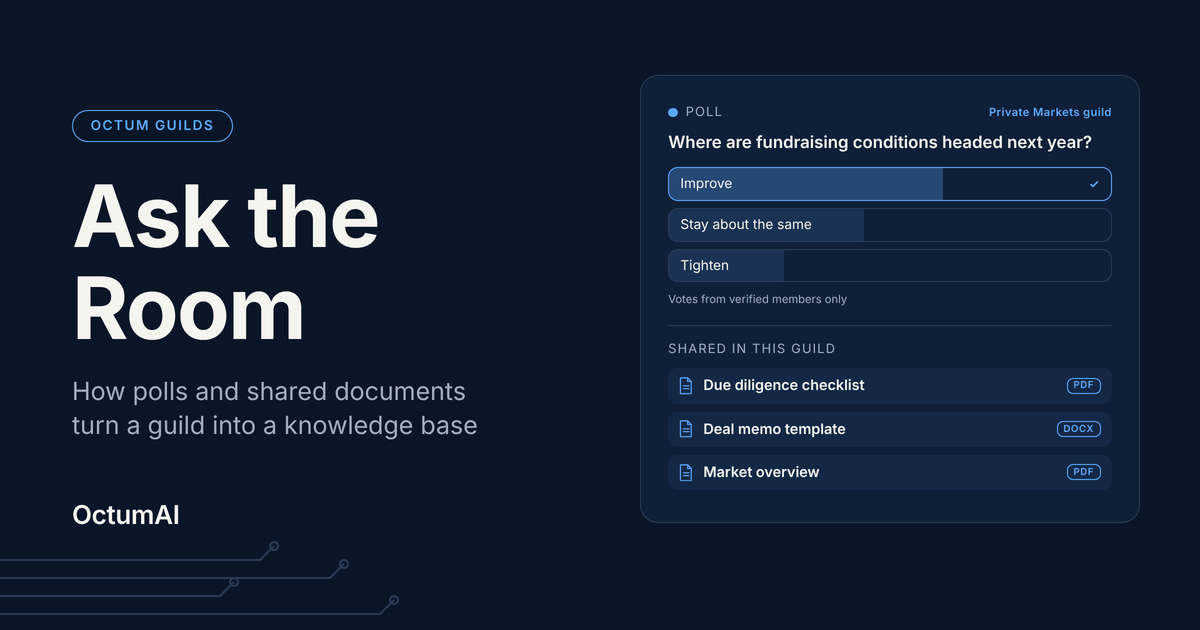
A poll in a guild puts your question in front of the professionals who share your field. Asking a Private Markets guild where they expect fundraising conditions to head next year, or an Education guild how their institutions are approaching AI policy, gets you a real read in hours instead of weeks.
What makes a guild poll different from one on an open social platform comes down to who’s answering.
- Every vote comes from a real member. Octum members are verified or vouched for by peers, so results reflect what professionals think, not what bots or brigades want you to see.
- The audience is relevant. A guild is already filtered by field. You don’t need a thousand random votes when you have fifty people who live in the subject.
- The results start a conversation. A surprising result is an invitation. The discussion that follows a poll is often more valuable than the numbers themselves.
Use polls to test an assumption before a meeting, see where consensus sits on a market question, decide which topic your guild’s next event should cover, or simply find out whether you’re the only one seeing a trend.
Shared documents: your field’s best work, in one place
Good professional knowledge often lives in documents: a deal memo template, a due diligence checklist, a market overview, a syllabus, a regulatory summary. Usually, those documents are scattered across inboxes and hard drives, shared once and then lost.
In a guild, members can share documents directly with the people who’ll use them. The document lives alongside the discussion it sparked, so context travels with it.
That creates a compounding effect. The checklist one member shares saves the next member a weekend. The market note another posts becomes the reference everyone points to. Over time, a guild builds a library that no individual could assemble alone.
And because every contributor is a verified or vouched-for professional, you know who’s behind what you’re reading. That’s the difference between a useful resource and a random PDF.
From conversation to collective memory
Most online discussion has a short half-life. A great answer gets posted, scrolls out of view and is gone.
Polls and shared documents change that. They turn a moment of conversation into something that lasts: a record of what the field thought, and a set of tools the field built. The next person who joins a guild doesn’t start from zero. They inherit everything the members before them shared.
That’s what a guild is for.
Try it in your guild
Got a question you’d like answered by people who actually know? Post a poll. Got a document that saved you hours? Share it with your guild and save someone else the same.