
Here’s a question worth asking before you act on anything you read online: who said it?
Not which account. Who. A real person with a real career, or a profile assembled last week? Someone who has done the work, or a bot recycling headlines? A practitioner sharing what they’ve seen, or a stranger with something to sell?
For most of the internet, you can’t answer that question anymore. And for professionals making decisions with real money, real careers and real reputations on the line, that’s a serious problem.
The trust problem is getting worse
Three forces are eroding trust in online professional spaces at the same time.
Bots and fake profiles. Generating a convincing profile, complete with photo, work history and a stream of plausible posts, now takes minutes. Many of the “people” commenting, connecting and messaging on open platforms aren’t people at all.
Misinformation that sounds right. The most dangerous bad information isn’t obviously wrong. It’s a confident claim about a deal, a fund or a market, stated without a source and repeated until it feels like consensus.
Bad data. Outdated contacts, inflated figures, scraped lists and unverifiable claims flow into spreadsheets, models and decisions. Bad inputs don’t announce themselves. They just quietly make your outcomes worse.
Open networks optimize for growth and engagement, so anyone can join and anything can be posted. That’s great for scale. It’s terrible for trust.
How Octum keeps the room real
Octum takes the opposite approach. Every member of the Octum community is either verified (third-party service) or vouched for by other members.
Verification confirms you are who you say you are. Vouching adds something verification alone can’t: a real person in the community putting their own name behind yours. It’s how trust has always worked in professional circles. You get introduced, someone speaks for you, and your reputation starts on solid ground.
The effect on the community is simple but powerful:
- Every voice belongs to a real person. When someone answers your question in a guild, you know a professional wrote it.
- Reputation carries weight. Members post under their real identity, so they think before they share, and they stand behind what they say.
- Bad actors have nowhere to hide. Spam, scams and coordinated manipulation depend on anonymity and disposable accounts. A verified community removes both.
Why it matters for your decisions
In a verified community, a poll result reflects what real professionals think, not what a bot farm wants you to believe. A shared document comes from someone accountable for it. A warm introduction leads to an actual person.
That changes how you can use what you find. Instead of treating every piece of information as suspect, you can start from a baseline of trust and spend your energy on judgment, not detective work.
Quality over quantity
A verified community grows more slowly than an open one. That’s the point.
We would rather have a guild of 500 professionals who know their field than 50,000 accounts of unknown origin. The value of a professional community isn’t in its member count. It’s in whether you can believe what you read there and trust the people you meet.
Join the room where everyone is real
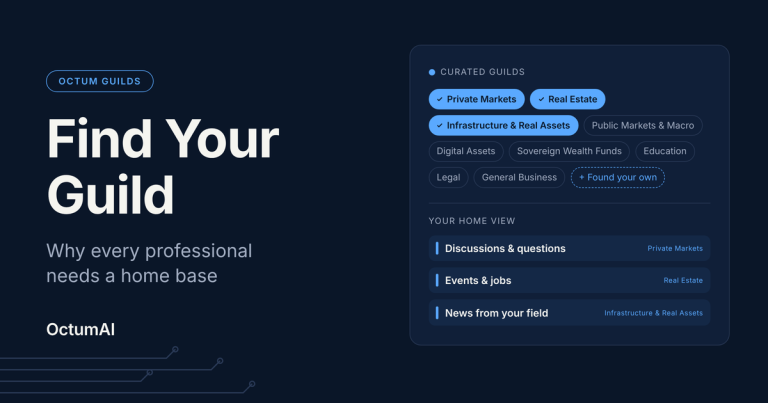
If you’re tired of wondering who’s on the other side of the screen, Octum is built for you. Get verified, or get vouched for by a colleague already on Octum, and find your guild.