Eighth in a series breaking down real prompts our members run on Ora, and why the wording matters as much as the data underneath it.
Asset-based finance has had the best fundraising run in private credit for two years. Allocators have heard the pitch: diversification away from sponsor-backed direct lending, cash flows secured by real collateral, and spreads that have held up while unitranche got crowded. If you run an ABF manager raising Fund II, the momentum is on your side.
Endowments are where it gets harder. They are some of the most sophisticated credit investors in the market, and some of the hardest to read. They rarely call anything “asset-based finance,” many disclose almost nothing, and the person who decides on your fund may not have “private credit” anywhere in their title.
The prompt below asks for exactly the right deliverable: one page per endowment that a partner can read in the car before a meeting. Getting a good tearsheet out of it depends on a few words that are easy to skip.
The prompt
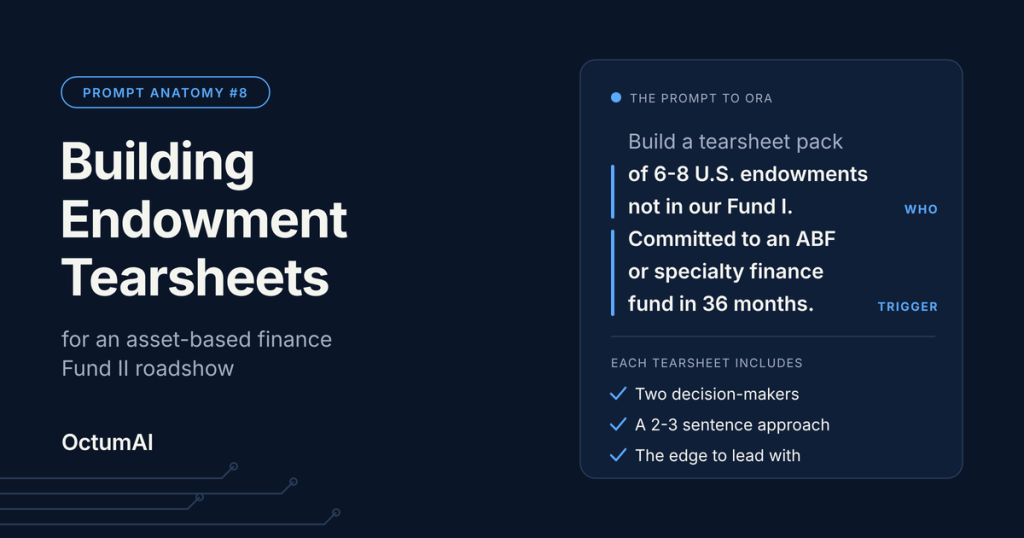
Build me a tearsheet pack of 6-8 U.S. endowments that have committed to an asset-based finance, specialty finance, or consumer/commercial receivables fund in the last 36 months, or that have created a dedicated ABF sleeve within private credit. I’m a Partner and Head of Capital Formation at an asset-based finance manager raising Fund II. Exclude any institution already in our Fund I LP roster. For each institution, give me: the two most relevant decision-makers (CIO and Head of Private Credit or equivalent) with title and email, a 2-3 sentence approach recommendation, and the edge we should lead with. One institution per page, formatted as a tearsheet I can hand to our partners before a roadshow.
What nobody says out loud: endowments don’t file ABF under ABF
The market tailwind is real. Specialty finance funds raised a record $47.4 billion in 2025, about a fifth of all private credit fundraising, up from 4% in 2024. Generalist ABF funds took just under $20 billion of that, including KKR’s $6.5 billion Asset-Based Finance Partners II. Consultants including Aon, Callan, Cambridge Associates, Mercer, and StepStone have recommended specialty finance to clients as a diversifier.
That tailwind cuts both ways for a Fund II. Every endowment credit team has now heard a dozen ABF pitches, several from platforms with ten times your capital. And the endowment you want is harder to find than the headline numbers suggest, for three reasons.
The label is wrong. Endowment reports use broad buckets: credit, absolute return, diversifying strategies, real assets. Consumer receivables, equipment leases and royalty pools get filed wherever the investment team decided they fit. A “dedicated ABF sleeve” is rare. An ABF commitment inside the credit or diversifiers bucket is common.
Disclosure is lopsided. Public university systems and their foundations often publish board materials. Most private universities publish an asset allocation and nothing more. Compare a public pension: Rhode Island’s treasury posted a full staff memo for a $30 million commitment to an asset-based credit fund, with pacing, portfolio fit and fees (Rhode Island Treasury, May 2025). An endowment will almost never show you that much. A 36-month commitment screen will surface the visible endowments, not necessarily the best ones.
The decision-maker often isn’t a Head of Private Credit. Endowment teams are small. Credit may sit with a generalist director, inside an absolute return team, or outside the building entirely with an outsourced CIO.
| Where ABF sits | What the report calls it | Who actually decides |
|---|---|---|
| Large endowment with a credit team | Private credit or credit | Director or MD of credit, with CIO sign-off |
| Endowment without a credit team | Absolute return or diversifying strategies | The generalist who covers hedge funds and credit |
| Real-asset-flavored ABF (equipment, aviation, royalties) | Real assets | Real assets lead |
| Endowment run by an OCIO | Whatever the OCIO’s model portfolio calls it | The OCIO’s credit research team |
So the useful question is not “who has an ABF sleeve.” It is “who has already underwritten collateral-backed credit, under any label, and who on their team did the work.”
The anatomy
“Build me a tearsheet pack of 6-8 U.S. endowments.” A cap of eight forces Ora to rank, which is the point. Say what the ranking is for: fit with your fund, not endowment size. Add a size floor, too. Below roughly $1 billion, few endowments have a credit specialist on staff, and many run through an outsourced CIO, which changes who you are pitching.
“That have committed to an asset-based finance, specialty finance, or consumer/commercial receivables fund.” Listing three labels is smart, because endowments use all of them and more. But “specialty finance” is wide. It also covers NAV lending, significant risk transfer and royalties, and a commitment to a NAV lender says little about appetite for consumer receivables. Ask Ora to name the fund and its sub-strategy so you can judge relevance yourself, and to search under any bucket name: credit, absolute return, diversifiers or real assets.
“In the last 36 months.” The right window. It covers the 2025 surge and the endowments that have now digested a first ABF commitment and are looking for a second. Ask for the date and source of each commitment, and have Ora mark it as reported or confirmed.
“Or that have created a dedicated ABF sleeve within private credit.” Keep it, but don’t expect many hits. A better secondary signal is an asset allocation review or investment committee minute that mentions asset-backed or collateralized credit. That is often the first public sign of a sleeve before it has a name.
“I’m a Partner and Head of Capital Formation at an asset-based finance manager raising Fund II.” Useful context for tone: the output is written for partners, not analysts. What’s missing is the fund itself. Without your target size, sub-sectors, typical facility size and Fund I results, Ora can’t tell a good fit from a bad one, and it can’t find your edge.
“Exclude any institution already in our Fund I LP roster.” Ora doesn’t know your roster unless you give it. Attach the list. Then decide two edge cases in advance: related entities (a university’s endowment and its separately managed foundation) and OCIO clients whose OCIO is already a Fund I LP.
“The two most relevant decision-makers (CIO and Head of Private Credit or equivalent).” “Or equivalent” are the two most important words in the prompt. At many endowments the equivalent is a director covering credit and hedge funds, or the OCIO’s credit researcher. Ask Ora to say why each person is the right one, citing their portfolio role or the commitments they worked on.
“With title and email.” Endowment investment staff rarely publish direct emails. Ask Ora to label each address as published or inferred from the domain’s pattern, and to note whether the office has a manager submission process. Some offices route all new managers through one, and skipping it starts you off on the wrong foot.
“A 2-3 sentence approach recommendation.” A good constraint. Make it earn its space by requiring each recommendation to rest on a dated fact: a recent commitment, a new hire, an allocation change, or a stated pacing plan.
“The edge we should lead with.” The best instinct in the prompt, and the easiest to waste. Your edge at a given endowment is not your strongest selling point in general. It is the gap in what they already own. If they hold a large diversified ABF fund, your edge may be smaller facilities, a sector they lack, or deployment that isn’t competing with the giants. Ask Ora to compare your strategy with their known ABF managers and name the gap.
“One institution per page, formatted as a tearsheet I can hand to our partners before a roadshow.” An excellent output spec. Tighten it with fixed fields in a fixed order so pages compare at a glance: snapshot, ABF evidence, decision-makers, approach, edge, open questions, sources and an as-of date. Ask Ora to group the pack by city, since a roadshow runs on geography.
What you do with the output
- Check every contact before a partner sends anything. Confirm names and titles against the investment office’s own staff page, and treat inferred emails as guesses until one gets a reply. Endowment teams turn over, and a stale CIO name on page one undermines the whole pack.
- Map the OCIO and consultant layer. For any endowment run by an outsourced CIO, the first meeting is with the OCIO’s credit team, not the university. One approval there can open several endowment clients at once.
- Rewrite each edge in your own voice. Ora finds the gap; your partners have to own the pitch. Have the partner taking the meeting rewrite the edge in one sentence they would actually say out loud.
- Bring the collateral, not the category. Endowment credit teams have heard “asset-based finance” many times. Lead with one specific pool, its loss history through stress, and how your structure protected it.
- Time it to their calendar. Many endowment investment committees meet quarterly. Ask Ora to note the next meeting date where it is public, and get in front of staff well before it, not the week of.
- Keep the pack alive. Re-run the prompt before each roadshow leg. New commitments, hires and allocation reviews change both the ranking and the edge.
Variants
Here is the prompt rewritten with the changes above:
I’m a Partner and Head of Capital Formation at an asset-based finance manager raising Fund II: $[size] target, focused on [consumer / commercial / equipment / other] collateral, with typical facilities of $[range]. Fund I: [vintage, size, headline results]. Our Fund I LP roster is attached; exclude those institutions, their related foundations, and any endowment whose OCIO is on the roster. Build a tearsheet pack of 6-8 U.S. endowments over $1B that, in the last 36 months, committed to an asset-based finance, specialty finance or consumer/commercial receivables fund under any bucket name (credit, absolute return, diversifiers, real assets), or whose allocation reviews or committee minutes mention asset-backed credit. Rank by fit with our strategy, not by size. For each: a snapshot (AUM, credit allocation, OCIO if any); ABF evidence (fund, sub-strategy, date, source, reported or confirmed); the two people who decide, with title, why each is the right one, and email labeled published or inferred; a 2-3 sentence approach grounded in a dated fact; and the edge we should lead with, based on the gap between our strategy and their existing ABF managers. One institution per page, fixed fields in the same order, grouped by city, with sources and an as-of date.
Three swaps that each open a different channel:
- Swap endowments for public pensions with published staff memos. Pensions often show their work. Rhode Island’s memo for its asset-based credit commitment noted specialty finance would make up 45% of its private credit exposure and named the managers already in the book (Rhode Island Treasury, May 2025). When the incumbents are on the record, the edge question nearly answers itself.
- Swap the commitment trigger for the OCIO layer. Ask which outsourced CIOs serving endowments added ABF managers in the last 36 months, and who leads credit research at each. One OCIO approval can reach dozens of smaller endowments the original prompt would never surface.
- Keep the endowments and swap the trigger to “no ABF yet.” Ask for endowments with a private credit program built mostly on direct lending and no visible collateral-backed exposure. These are first-time ABF allocators. Many will default to a large platform for a first ABF commitment, so the pitch becomes why a focused Fund II is the better place to start.
Why this is a prompt and not a database query
No database field is called “endowment that has underwritten collateral-backed credit under some other label, and the person there who did the work.” That answer is spread across endowment reports, public university board materials, pension staff memos, fund close announcements, staff bios and trade press. A conventional database can tell you an endowment exists and roughly what it owns. It can’t tell you what gap your fund fills in its book.
Ora reasons across those sources and returns the synthesis with its working shown, so you can check a commitment, a title or an edge against the source before a partner walks into the room. The prompt is the specification. The more precisely you write the constraints, the less time your team spends rewriting the tearsheets.
One practical note: fund marketing is regulated, and tearsheets that partners carry into meetings should be reviewed by compliance like any other marketing material. Treat inferred emails and reported commitments as leads, not facts, and respect any endowment’s stated process for new managers. The pack gets you to the right people. How you earn the meeting is still your call.
This is the eighth post in Prompt Anatomy, where we take a real prompt run on Ora and break down why it is written the way it is. Have one you want dissected? Send it to support@octum.ai.
New to Octum? Ora is our research engine for institutional investing, built on GAR, our own cognitive architecture. Join in about three minutes.