Ask most professionals how they feel about networking and you’ll get a wince.
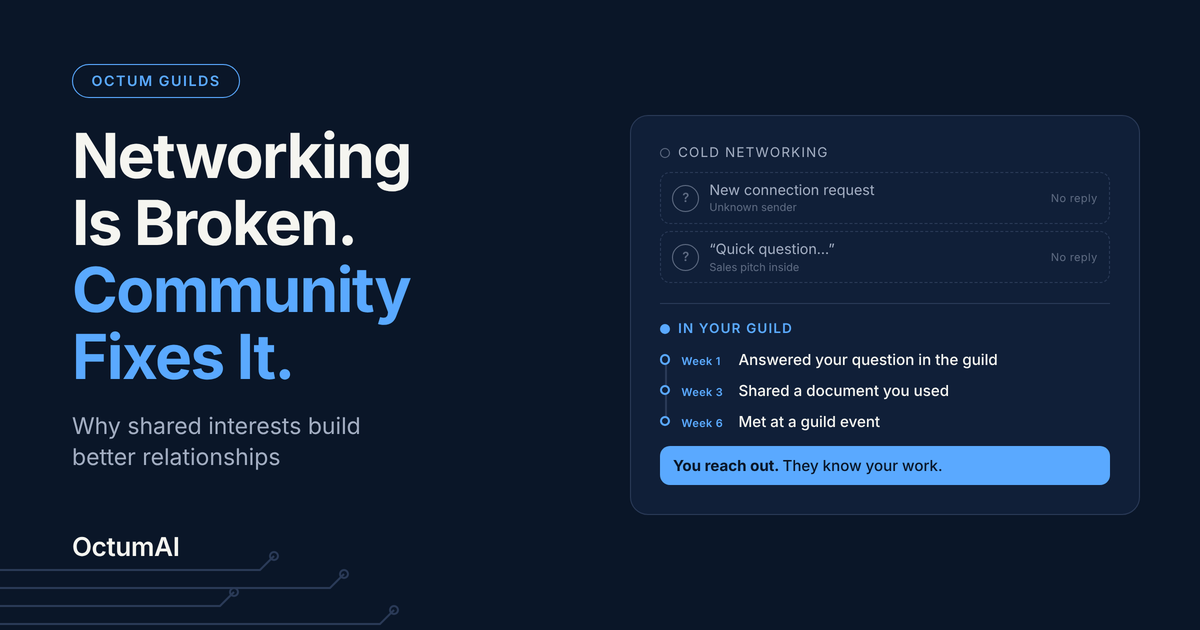
It conjures up name tags, forced small talk and a stack of business cards that never become anything. Online, it’s worse: a connection request from a stranger, followed immediately by a sales pitch. An inbox full of “quick question” messages. A network of thousands where you’d struggle to name fifty people who’d return your call.
The problem isn’t networking itself. Relationships are still how careers grow, deals happen and good ideas spread. The problem is that most networking starts in the wrong place.
Relationships start with something in common
Think about the professional relationships that actually matter to you. Chances are, very few began with a cold message. They started on a project, in a working group, at the same table in a seminar, or arguing over the same problem.
In other words, they started with a shared interest and grew through repeated contact. You saw how someone thought before you ever asked them for anything.
That’s how community works, and it’s why community-first networking beats transactional networking every time.
How guilds make networking natural
On Octum, you don’t start by collecting connections. You start by joining guilds: communities of professionals who share a field or an interest.
Inside a guild, relationships form on their own:
- You meet people through the work. Answer a question well, share a useful document or start a good discussion, and the right people notice. Your contributions introduce you.
- Shared interests are built in. Everyone in a Real Estate or Digital Assets guild already cares about the same things you do. There’s no awkward search for common ground.
- Repeated contact builds trust. You see the same members in discussions, polls and events over weeks and months. By the time you reach out directly, you’re not a stranger.
- Events and jobs come through people you know. Opportunities posted in a guild come from a community, not an anonymous feed.
Why it only works when everyone is real
Community-first networking depends on one thing: trust. You can only build a relationship with someone who is who they say they are.
That’s why every Octum member is verified or vouched for by other members. No bots padding the member count. No fake profiles fishing for contacts. No anonymous accounts posting whatever gets attention. When you meet someone in a guild, you’re meeting a real professional who someone else was willing to stand behind.
Vouching also reflects how real networks have always worked. The strongest introductions come from people you trust. On Octum, that principle is built into membership itself.
From network size to network strength
The old networking scoreboard was a count: connections, followers, cards collected. It measured reach, not relationships.
Community changes the measure. A strong network is one where you can ask a real question and get a real answer, where an introduction carries weight, and where you can give as much as you take. That kind of network can’t be bought or automated. It has to be built, one shared conversation at a time.
Start with your interests
You don’t need a networking strategy. You need a room full of people who care about what you care about.
Find the guilds that match your field and your interests, join the conversation, and let the relationships follow.