Capital raising: key facts at a glance
Capital raising is the process of securing money from investors, lenders or institutions to fund a business, a project or an investment fund, in exchange for equity, debt or a hybrid of the two.
| Fact | Figure | Source |
|---|---|---|
| Global private capital raised, H1 2026 | $658.1 billion across 1,499 funds | PitchBook Q2 2026 Global Private Market Fundraising Report |
| Private capital raised, 12 months to June 30, 2026 | $1.35 trillion, down 12.7% year over year; fund count down 37.0% | PitchBook, same report |
| Share of H1 2026 capital won by funds over $1 billion | 78.2%, up from 59.1% in 2021 | PitchBook, same report |
| First-time private equity funds, H1 2026 | $7.7 billion across 36 funds (vs. $21.3 billion across 123 funds in 2025) | PitchBook, same report |
| Average time for a venture fund to close | A record 17.5 months | Institutional Investor, citing PitchBook (Dec. 2025) |
| Private markets assets under management | $16.7 trillion (Dec. 2025), up from $6.1 trillion in 2016 | PitchBook Q2 2026 report |
| Median U.S. Series A round | $20.0 million in Q1 2026, up from $14.0 million in Q1 2025 | J.P. Morgan Startup Insights H1 2026, PitchBook data |
| Median U.S. seed round | $3.0 million in Q1 2026 | J.P. Morgan, same report |
| Regulation Crowdfunding limit | $5 million per 12 months | SEC amendments, via Haynes Boone |
| Regulation A Tier 2 limit | $75 million per 12 months | Same |
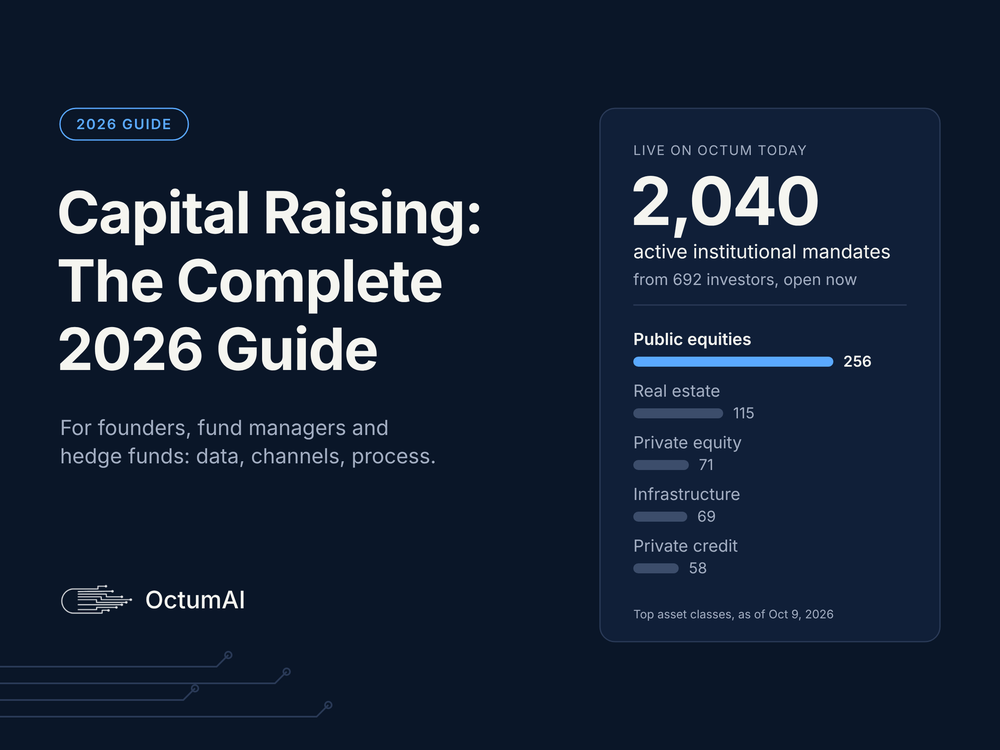
| Active institutional RFPs tracked by Octum | 2,040 from 692 institutional investors (as of Oct. 9, 2026) | octum.ai |
The short version: capital is available, but it is concentrating. Large, established fund managers and later-stage companies are winning a growing share, while first-time funds and early-stage raises take longer and must target investors more precisely than at any point in the last decade.
What is capital raising?
Capital raising is how a business, project or investment fund gets the money it needs to operate, grow or invest. The capital comes from outside investors or lenders, and they receive something in return: an ownership stake (equity), a promise of repayment with interest (debt), or a mix of both (hybrid instruments).
When people ask “what is equity?” in this context, they mean ownership. In equity financing, investors receive a share of the business, and its future profits, in exchange for their capital. In debt financing, the owner keeps full control but must repay the loan on a schedule.
Who raises capital
The term covers several very different activities. This guide addresses each one.
| Who is raising | What they raise | Typical sources of capital | Jump to |
|---|---|---|---|
| Startups and growth companies | Seed, Series A–D, growth equity, venture debt | Angels, venture capital firms, corporate VCs, growth equity funds | Capital raising by company stage |
| Established private and public companies | Bank loans, bonds, private placements, IPOs, secondary offerings | Banks, bond investors, private equity, public markets | Equity vs. debt vs. hybrid |
| Fund managers (GPs) | Commitments to private equity, venture, credit, real estate, infrastructure and hedge funds | Pension funds, endowments, foundations, insurers, sovereign wealth funds, family offices, wealth platforms | Fund capital raising |
| Real estate and project sponsors | Deal-by-deal equity, joint ventures, construction debt | Family offices, real estate funds, banks, syndicates | Capital raising channels |
Why it matters more in 2026
The supply of capital is large but selective. Private markets assets under management reached $16.7 trillion at the end of 2025, according to PitchBook. Yet the number of funds closing fell 37% in the year to June 2026, and the largest managers took most of the money. For founders, round sizes at Series A have risen sharply, but so has the bar to earn one.
In practice, the raisers who succeed are not just those with good numbers. They find the right investors earlier, reach the real decision makers, and run a disciplined process from first meeting to close.
Equity vs. debt vs. hybrid financing
Every capital raise is built from three basic instruments. The right mix depends on how much control you are willing to give up, how predictable your cash flows are, and how fast you need the money.
| Equity financing | Debt financing | Hybrid and structured financing | |
|---|---|---|---|
| What the investor gets | Ownership and a share of future profits | Repayment of principal plus interest | A debt claim that can convert to equity, or preferred economics |
| Repayment | None; investors profit through growth, dividends or an exit | Fixed schedule, regardless of performance | Varies; often deferred until conversion or maturity |
| Effect on ownership | Dilutes existing owners | No dilution | Dilution is delayed or capped |
| Cost of capital | Highest, if the business succeeds | Lowest for creditworthy borrowers | In between |
| Control | Investors may take board seats and approval rights | Lenders impose covenants, not votes | Investor rights negotiated case by case |
| Common forms | Angel and venture rounds, private equity, equity crowdfunding, IPOs | Bank loans, credit lines, corporate bonds, venture debt, private credit | Convertible notes, SAFEs, preferred stock, mezzanine debt, revenue-based financing |
| Best for | High-growth companies without steady cash flow | Businesses with stable, predictable cash flow | Early rounds where valuation is hard to set, or capital structures that need flexibility |
Other alternative methods include invoice factoring and merchant cash advances. They are fast but expensive, so treat them as short-term tools rather than a funding strategy.
A note on private credit. Lending by non-bank funds is now one of the largest sources of business financing. Private debt funds raised $275.2 billion in 2025 and $158.3 billion in the first half of 2026 alone, according to PitchBook. For mid-sized companies, a private credit lender is often a realistic alternative to a bank.
Capital raising by company stage
A company’s stage decides which investors are realistic and how much it can raise. Early-stage startups rely on personal networks, angels and accelerators. Growth-stage companies need larger checks from venture, growth equity and non-traditional investors.
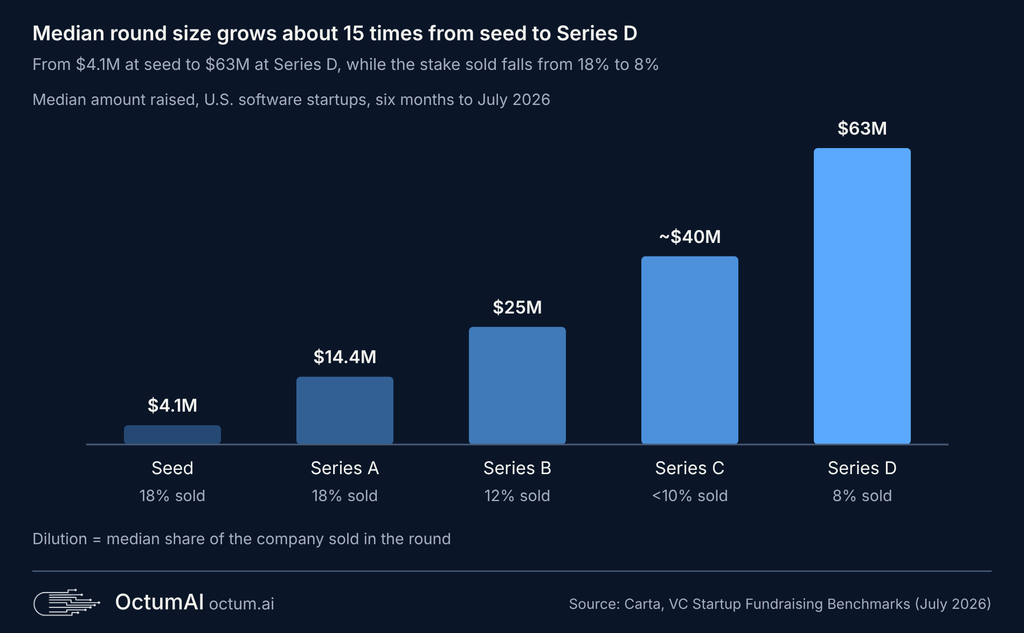
Data sources differ. PitchBook data in J.P. Morgan’s Startup Insights report puts the median U.S. Series A across all sectors at $20.0 million in Q1 2026, up from $14.0 million a year earlier, and the median seed round at $3.0 million. Carta’s figures cover software rounds on its cap tables.
Stage by stage: who funds what
| Stage | Typical sources | What investors look for | What it sets up |
|---|---|---|---|
| Pre-seed and bootstrapping | Founders’ savings, early revenue, friends and family | Founder commitment, a real problem | Full control while you prove the idea |
| Seed | Angels, seed funds, accelerators and incubators, equity crowdfunding, SBA loans | Team, product and market | Valuation, dilution and board terms that later rounds build on |
| Series A | Venture capital firms | Revenue growth, a growing customer base, partnerships, positive unit economics, protected IP | Formal governance and a lead investor on the board |
| Series B–D and growth | Larger VC funds, growth equity, asset managers, sovereign wealth funds, private equity, venture debt | Efficient growth, a path to profitability, exit options | Scale, and preparation for an IPO or sale |
| Public markets | IPO investors, follow-on offerings | Audited financials, predictable growth, governance | Liquidity and access to broad capital |
Plan each round around milestones. Many founders raise enough to fund 18 to 24 months of operations, which leaves time to hit milestones without rushing the next raise. Decide in advance how much ownership you are willing to sell in each round.
Choose your lead investor carefully. Each priced round usually has a lead investor who writes the largest check, often takes a board seat, and signals confidence to everyone else. You will work with that firm for years.
Know what diligence will cover. Series A and later investors review financial statements, the cap table and key contracts, not just the deck. Have these metrics ready: annual recurring revenue growth, unit profitability, customer acquisition cost, churn and customer lifetime value.
Tips for running a startup raise
- Be clear on your edge and your model. Investors need to understand the problem you solve, your audience, how you scale, how you make money and the path to profitability.
- Build relationships before you need them. Warm introductions consistently outperform cold outreach.
- Talk to many investors, and diligence them too. An investor’s network, sector experience and working style matter for years.
- Don’t take a pass personally. Fund stage, portfolio concentration, sector focus and timing all drive decisions. A clear no today can keep the door open for the next round.
- Keep your books clean. Organized financials and a tidy cap table shorten diligence and signal maturity.
Regulatory pathways for raising capital in the U.S.
In the U.S., every securities offering must be registered with the SEC or qualify for an exemption. Most private companies and nearly all private funds raise under an exemption. The table compares the main options, using the SEC’s exempt offerings overview.
| Pathway | Maximum raise | Who can invest | Can you advertise? | Key filing |
|---|---|---|---|---|
| Rule 506(b), Regulation D | No limit | Unlimited accredited investors, plus up to 35 non-accredited investors in any 90-day period | No general solicitation | Form D within 15 days of first sale |
| Rule 506(c), Regulation D | No limit | Accredited investors only, with reasonable steps to verify status | Yes | Form D within 15 days of first sale |
| Rule 504, Regulation D | $10 million in 12 months | Varies by state | Limited; depends on state rules | Form D |
| Regulation Crowdfunding | $5 million in 12 months | Anyone; non-accredited investors face annual limits | Yes, through a registered funding portal or broker | Form C |
| Regulation A, Tier 1 | $20 million in 12 months | Anyone | Yes | Form 1-A, plus state review |
| Regulation A, Tier 2 (“Reg A+”) | $75 million in 12 months | Anyone; non-accredited investors face limits | Yes | Form 1-A and ongoing reports |
| Registered offering (IPO) | No limit | Public | Yes, within SEC rules | Registration statement (Form S-1) |
Regulation Crowdfunding and Regulation A limits reflect SEC amendments that raised the caps from $1.07 million and $50 million respectively (Haynes Boone).
Why Rule 506(c) matters more now. Rule 506(c) lets issuers, including private funds, advertise publicly as long as every buyer is accredited. The hurdle was verification. In a no-action letter of March 12, 2025, SEC staff said high minimum investments can satisfy verification: $200,000 for individuals and $1 million for entities, backed by written representations that the investment is not third-party financed. For many fund managers, that makes public marketing, including thought leadership and investor webinars, far more practical.
This is a summary, not legal advice. Confirm the exemption, state “blue sky” filings and any non-U.S. rules with securities counsel before you market.
Fund capital raising: who the LPs are and what the market looks like
Fund capital raising is the process by which a fund manager, the general partner (GP), secures commitments from investors, the limited partners (LPs), to a private equity, venture capital, private credit, real estate, infrastructure or hedge fund. The GP invests the pooled capital and earns management fees and a share of profits; the LPs supply most of the money and share in the returns.
Who invests in funds
| Investor type | What drives them | What they usually need from a manager |
|---|---|---|
| Public and corporate pension funds | Long-term liabilities, fiduciary rules, board oversight | Institutional track record, consultant approval, often a formal RFP |
| Endowments and foundations | Perpetual horizon, spending policy | Differentiated strategy, alignment, often an OCIO or consultant relationship |
| Insurance companies | Liability matching, capital treatment | Credit and income strategies, ratings considerations, often SMAs |
| Sovereign wealth funds | Scale, national objectives, long horizons | Large ticket capacity, co-investment, local presence |
| Family offices | Wealth preservation, flexibility | Relationships, niche opportunities, faster decisions |
| Funds of funds and wealth platforms | Diversified access for smaller investors | Evergreen or semi-liquid structures, reporting at scale |
The 2026 fundraising market in numbers
Private capital fundraising is still well below its 2021–2022 peak, and the decline has been uneven across strategies.
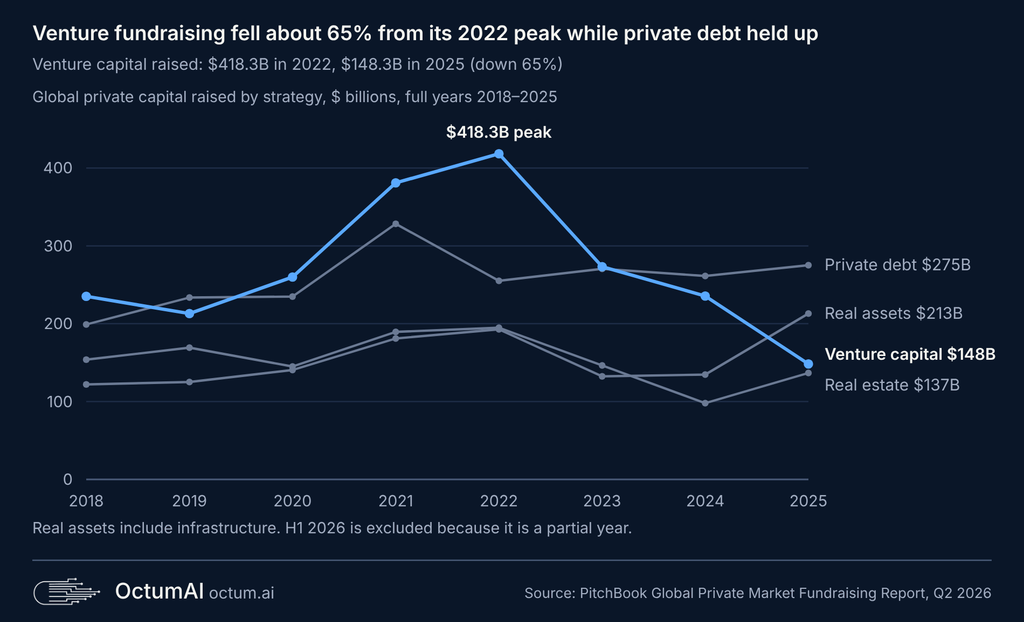
- Capital is concentrating. Funds over $1 billion took 78.2% of capital raised in H1 2026, up from 59.1% in 2021. In private equity, 77% of capital since 2024 has gone to funds over $1 billion (PitchBook).
- Fewer funds are closing. In the 12 months to June 2026, 3,763 funds closed, down 37.0% year over year, while capital raised fell 12.7% to $1.35 trillion.
- First-time funds are squeezed. First-time private equity funds raised $7.7 billion across 36 funds in H1 2026, after $21.3 billion across 123 funds in 2025.
- Raises take longer. Venture funds took a record 17.5 months on average to close (Institutional Investor). Real estate funds took a median 19.6 months to close in 2025 and 14.6 months in H1 2026, per PitchBook.
- There is still capital to deploy. Private markets held $3.99 trillion of dry powder at the end of 2025, and assets under management reached $16.7 trillion.
Capital raising channels for fund managers
Fund managers reach capital through six main channels. Most successful raises combine two or three of them, matched to the fund’s size, track record and target investors.
| Channel | How it works | Best for | Watch out for |
|---|---|---|---|
| Direct outreach | The GP markets its track record, strategy and team directly to allocators | Managers with existing LP relationships and a clear niche | It takes dedicated investor relations capacity and good investor data |
| Placement agents | Regulated third parties, such as Probitas Partners, Campbell Lutyens, PJT Park Hill and, for Gulf investors, Greenstone, introduce the fund to their LP networks | Larger raises, new geographies, managers without a full IR team | Fees, usually a percentage of capital raised plus a retainer; pay-to-play rules for public plans |
| Investment consultants and RFPs | Consultants screen managers for pensions and foundations; many searches run through formal RFPs | Strategies with institutional track records | Database profiles, minimum requirements and quiet periods. See our investment RFP guide and Prompt Anatomy #6 on consultant gatekeepers |
| Emerging manager programs and seeders | Pensions and seed investors back early-stage managers, directly or through program partners | Funds I–III and diverse-owned firms | Programs set AUM caps and apply full institutional diligence |
| Separately managed accounts (SMAs) | A single large investor gets its own account managed to your strategy | Credit and real asset managers selling to insurers and large pensions | Higher operational load; customized terms. See Prompt Anatomy #1 on insurance SMAs |
| Co-investment, SPVs and continuation vehicles | Deal-by-deal vehicles and GP-led secondaries alongside the main fund | Building relationships before a flagship raise; offering liquidity | Allocation fairness and conflicts. See continuation vehicles |
Emerging manager programs: real examples
- Maryland State Retirement and Pension System: its Terra Maria program held about $5.8 billion, or 7.6% of plan assets, as of March 2026. For private equity, private credit and real estate, it targets Funds I–III with under $2 billion of AUM at investment.
- New York’s public plans: the second annual Emerging Managers Week, in February 2026, brought together the NYC Comptroller’s Office, the New York State Common Retirement Fund, NYSTRS and NYSIF, representing more than $1 trillion in assets.
- CalPERS: runs an always-open investment proposal portal, and may refer proposals to its emerging manager partners.
How managers shift channels as they mature
Sources of capital change as a manager’s track record grows. Funds I and II rely on the GP’s own capital, friends and family, high-net-worth investors, family offices and emerging manager programs. By Funds III to V, managers are more likely to win commitments from pension funds, endowments, insurers and sovereign wealth funds, which need an institutional track record, a stable team and audited performance before they commit.
How to raise capital for a fund: the process step by step
A fund raise runs in eight stages. The first four happen before most investors ever see a pitch, and that preparation decides how fast the rest goes.
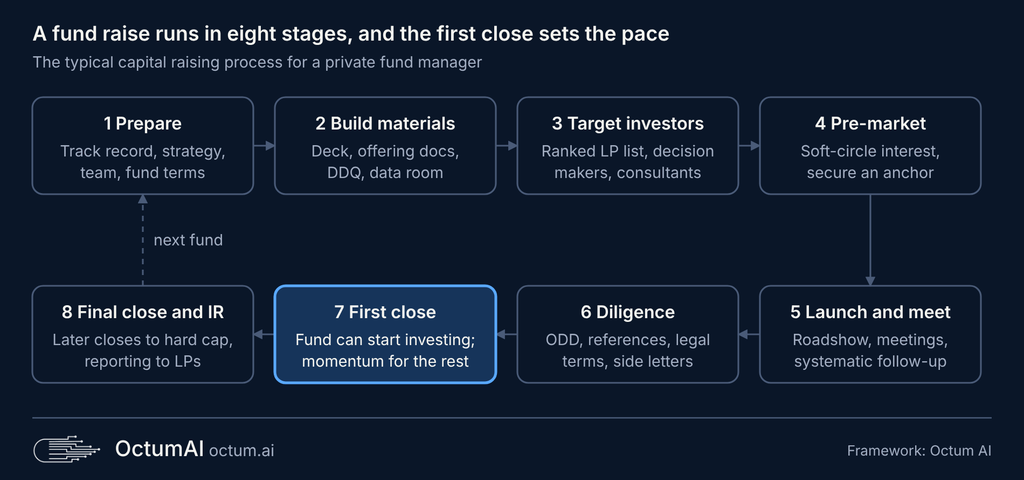
| Stage | What to do | Common mistake |
|---|---|---|
| 1. Prepare | Define the strategy and edge, document an attributable track record, settle fund size, terms and fees | Launching before the track record and team story are clear |
| 2. Build materials | Pitch deck, private placement memorandum, limited partnership agreement, a standard DDQ and a data room | Materials that contradict each other on numbers or terms |
| 3. Target investors | Build a ranked list of LPs that have recently backed similar strategies; name the decision makers and gatekeepers | A long generic list and cold outreach |
| 4. Pre-market | Test terms with friendly LPs, soft-circle commitments and secure an anchor investor | Going broad without a lead commitment |
| 5. Launch and meet | Run the roadshow, follow up after every meeting, track everything in a CRM | Letting momentum stall between meetings |
| 6. Diligence | Respond to operational due diligence, references and legal review; negotiate side letters | Slow DDQ responses and inconsistent answers |
| 7. First close | Close with enough capital to start investing; it gives later investors confidence | Setting the first-close target too high |
| 8. Final close and investor relations | Hold later closes up to the hard cap; report to LPs on a fixed schedule | Treating investor relations as finished once the money is in; today’s LPs are the next fund’s anchors |
Lead investors matter for funds too. An anchor LP, often a family office, a seeder or a large institution, gives others the confidence to commit. Many anchors negotiate fee discounts or co-investment rights in return.
Investor targeting: from static lists to agentic capital research
Most raises fail at the targeting stage, long before the pitch. A generic list of several hundred “investors in your asset class” produces cold emails, low response rates and months of wasted meetings. The raisers who close faster start from a short list of investors who have recently done exactly what they need: committed to a similar strategy, at a similar ticket size, through a channel they can actually reach.
What good investor targeting looks like
| Question | Weak answer | Strong answer |
|---|---|---|
| Who do we target? | “Pensions that invest in private credit” | North American insurers above $10 billion that awarded a private credit SMA in the last 24 months |
| Why now? | They have an allocation | A new target allocation, an open RFP, a manager termination or a recent re-up with a peer fund |
| Who decides? | The CIO’s generic inbox | The named head of private credit, the investment consultant’s real estate research lead, the board’s investment committee chair |
| How do we reach them? | Cold email | A warm introduction, a consultant database update, an RFP response or an emerging manager program submission |
| What do we know before the call? | Their AUM | Their allocation targets, recent commitments, consultant, decision timeline and the managers they already use |
Agentic capital research
A new generation of tools does this work in plain English. Instead of filtering a database and exporting rows, a raiser describes the investor they need and an AI research agent finds, ranks and explains the matches. Octum calls this agentic capital research.
Octum’s research agent, Ora, runs on Octum’s own cognitive engine, GAR. Members use it to:
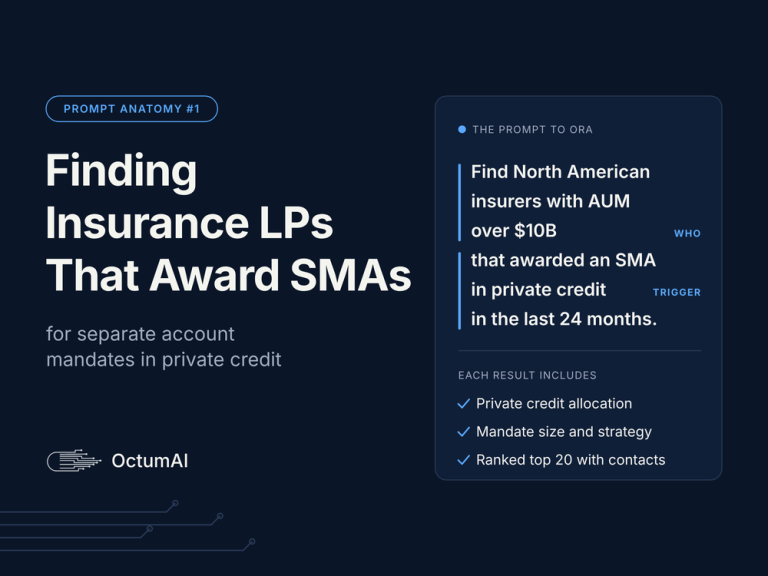
- Find investors by behavior, not labels. For example: “Find North American insurers with AUM over $10 billion that awarded a separate account mandate to a private credit manager in the last 24 months.” (See the full prompt breakdown.)
- Map the gatekeepers. For example, the lead real estate research contacts at the top U.S. investment consultants. (See Prompt Anatomy #6.)
- Track live mandates. Octum tracks 2,040 active institutional RFPs from 692 investors across public equities, real estate, private equity, infrastructure, private credit, multi-asset, fixed income and hedge funds, as of October 9, 2026.
- Understand the people. Executive and board profiles, certifications, education, career paths, affiliations, relationship mapping and 13F filing analysis turn cold outreach into an informed conversation.
- Draft the next step. Ora can draft outreach to decision makers and plan a roadshow of investor meetings in a given city, while the raiser keeps every decision.
Whatever tool you use, verify before you send. Confirm contacts, quiet periods and allocation details against primary sources such as board minutes, RFP documents and annual reports. Good research shortens a raise; a wrong name in a cold email lengthens it.
Hedge fund capital raising: eight practical steps
A hedge fund’s assets under management (AUM) drive its economics and often its capacity to execute its strategy. Hedge funds raise capital continuously rather than in a single fundraising period, from high-net-worth individuals, family offices, funds of hedge funds, endowments, foundations and pensions. Many managers start by investing their own money to build a track record that larger investors will trust.
- Build a credible foundation. Define what sets your strategy apart, document a track record from your own capital or prior roles, and write a business plan covering fund structure, strategy, projections and which functions you will outsource. Institutional investors expect independent administration, audit and a clear operational setup from day one.
- Profile your target investors. Decide whether you are selling to wealthy individuals, family offices or institutions; the pitch, minimums and diligence differ for each. Use investor intelligence tools such as Octum to find allocators whose mandates match your strategy, and learn who makes the decision before you reach out.
- Write a pitch that tells a story. Cover your edge, process, performance, risk management, team and fees in a clear, concise deck. Show when the strategy struggles and how you manage it; sophisticated investors trust candor.
- Work your network and build relationships early. Seed capital usually comes from personal and professional networks, which also open doors to larger investors. Investors who pass today often commit after a longer track record, so stay in touch.
- Use digital channels carefully. A professional website and thought leadership build credibility, but fund marketing is regulated. Unless you rely on Rule 506(c), avoid anything that reads as advertising a specific fund. See the compliance section.
- Earn trust through transparency. Send regular letters that explain performance, positioning and any changes in strategy. Be open about risks, and ask investors for feedback.
- Use external support where it adds reach. Capital introduction teams, third-party marketers and placement agents can accelerate a raise. Fees are typically a share of management fees or of capital raised, sometimes with a retainer. Check the agent’s track record with funds like yours.
- Follow up with a system. Track every investor conversation, next step and objection in a CRM. Most hedge fund allocations come after multiple meetings over months, often years.
Expect the bar to rise with each investor type. Family offices may commit on a strong relationship and a short record. Funds of hedge funds and institutions typically want a multi-year audited track record, meaningful AUM and a full operational due diligence questionnaire (DDQ), such as the AIMA illustrative DDQ.
Capital raising compliance: the rules that trip up raisers
Compliance failures can stop a raise outright, and they are almost always avoidable. These are the rules fund managers and companies run into most often.
| Rule | Who it affects | What it requires | Source |
|---|---|---|---|
| General solicitation (Rule 506(b) vs. 506(c)) | Private companies and private funds | Under 506(b), no public advertising. Under 506(c), advertising is allowed, but every investor must be a verified accredited investor | SEC exempt offerings; King & Spalding on the 2025 no-action letter |
| Form D | Issuers relying on Regulation D | File a notice on EDGAR within 15 days of the first sale; no SEC filing fee | SEC exempt offerings |
| SEC Marketing Rule (Rule 206(4)-1) | SEC-registered investment advisers | Performance shown gross must also be shown net; testimonials, endorsements and hypothetical performance are restricted | SEC Marketing Rule FAQ, updated Jan. 15, 2026 |
| Pay-to-play (Rule 206(4)-5) | Advisers seeking or managing public plan money | A two-year ban on compensation after certain political contributions; limits on paying third-party solicitors | SEC small entity compliance guide |
| Placement agent registration | Third parties paid to raise capital | Agents generally must be registered broker-dealers; many public plans also require fee disclosure | Check with counsel; state and plan rules vary |
| AIFMD marketing rules | Managers marketing to European investors | EU managers can use a marketing passport; non-EU managers rely on each country’s national private placement regime, with pre-marketing rules on top | UK Private Capital on AIFMD; Linklaters on private placement |
| AML / KYC | Everyone accepting investor money | Verify investor identity and source of funds before accepting a subscription | Octum glossary: AML / KYC |
Three habits that prevent most problems:
- Decide on 506(b) or 506(c) before any public marketing. A podcast, LinkedIn post or conference talk about an open fund can count as general solicitation.
- Have compliance review every investor-facing number. Pitch decks, DDQs and emails count as advertisements under the Marketing Rule.
- Run a political contribution check before approaching any public pension. One small contribution by a covered employee can block fees for two years.
This section is a summary for orientation, not legal advice.
Common capital raising challenges and how to overcome them
| Challenge | Why it happens | How to overcome it |
|---|---|---|
| Investor skepticism | Investors are underwriting your team and plan, not just your numbers | Lead with evidence: customer growth, partnerships, an audited record. Explain exactly how the money will be used |
| Concentration of capital | Funds over $1 billion took 78.2% of private capital raised in H1 2026 (PitchBook) | Target investors that need smaller or specialist managers: emerging manager programs, family offices, SMAs and co-investment |
| Longer fundraising timelines | Venture funds now average a record 17.5 months to close (Institutional Investor) | Plan for 12–18 months, secure an anchor investor early, and use a first close to build momentum |
| Market volatility and timing | Investors grow cautious and lenders tighten in downturns | Track rate and allocation cycles; if conditions are poor, raise a smaller bridge round or extend runway |
| Dilution and loss of control | Repeated equity rounds shrink founders’ stakes and add board seats | Raise to milestones, negotiate valuation and governance terms, consider convertibles or venture debt |
| Reaching the real decision maker | Generic inboxes and gatekeepers filter cold outreach | Map the investment team, consultant and board before outreach; ask for warm introductions |
| Compliance and regulatory hurdles | Securities, marketing, AML and cross-border rules apply even to private raises | Choose the offering exemption up front, have compliance review materials, and engage counsel in each jurisdiction |
| Denominator effect and slow distributions | LPs that have received little cash back from existing funds have less to commit | Offer liquidity solutions, emphasize distributions in your track record, and target LPs that are under-allocated |
Capital raising readiness checklist
Work through this list before your first investor meeting.
Story and materials
- One-sentence description of what you do and why you will win
- Pitch deck: strategy, edge, team, track record, risk management, terms and fees
- Financial model or fund model with clear assumptions
- Use of proceeds tied to specific milestones
Numbers and diligence
- Audited or reviewed financial statements and clean books
- Organized cap table (companies) or GIPS-style performance record (funds)
- Data room ready: legal documents, contracts, policies, references
- Completed standard DDQ, such as the ILPA DDQ 2.0 for private funds
Investors and pipeline
- Ranked list of target investors who have recently backed similar companies or strategies
- Named decision makers and gatekeepers for each, with a route to a warm introduction
- Active RFPs and emerging manager programs that fit your strategy
- Lead or anchor investor targeted before a broad launch
- CRM set up to track every conversation and follow-up
Legal and compliance
- Offering exemption chosen (for example, Rule 506(b) or 506(c)) before any public marketing
- Marketing materials reviewed by compliance
- Pay-to-play contribution check completed if approaching public plans
- AML/KYC process ready for subscriptions
- Non-U.S. marketing rules confirmed for each target country
Capital raising glossary
| Term | Definition |
|---|---|
| Accredited investor | An investor who meets SEC income, net worth or professional tests and can buy unregistered private offerings |
| AUM (assets under management) | The total market value of assets a manager invests on behalf of clients |
| Anchor investor | A large early commitment that gives a fund credibility and momentum, often in exchange for better terms |
| Capital call | A GP’s request for LPs to fund part of their commitment when the money is needed for investments |
| Commitment | The amount an LP agrees to invest in a fund over its life |
| Convertible note / SAFE | Early-stage instruments that convert into equity at a later priced round |
| Dilution | The reduction in existing owners’ percentage stake when new shares are issued |
| Dry powder | Committed capital that has not yet been invested |
| First close / final close | The first and last points at which a fund admits investors; a first close lets the fund start investing |
| General partner (GP) | The firm that manages a fund and makes its investment decisions |
| Hard cap | The maximum size a fund will accept |
| Limited partner (LP) | An investor in a fund, such as a pension, endowment or family office |
| Placement agent | A regulated intermediary paid to introduce a fund to investors |
| Side letter | An agreement giving one LP terms that differ from the main fund documents |
| Soft cap | A fund’s target size, which it may exceed up to the hard cap |
| Target fund size | The amount a GP aims to raise for a fund |
| TVPI | Total value to paid-in capital: a fund’s realized plus unrealized value divided by capital called |
| Vintage year | The year a fund first invests capital, used to compare funds of the same era |
| Virtual data room (VDR) | A secure online space for sharing diligence documents with investors |
See the full Octum investment glossary for more than 50 additional terms.
Capital raising FAQ
What is capital raising? Capital raising is the process of securing money from investors, lenders or institutions to fund a business, project or investment fund, in exchange for equity, debt or a hybrid instrument.
What are the main ways to raise capital? The three main methods are equity financing (selling ownership), debt financing (borrowing and repaying with interest) and hybrid financing (instruments such as convertible notes, SAFEs and preferred stock that combine features of both).
How long does it take to raise a fund? It varies by strategy and manager. Venture capital funds took a record average of 17.5 months to close, according to PitchBook data reported in December 2025. Plan for 12 to 18 months for most first-time and emerging manager funds.
How much is a typical Series A round? The median U.S. Series A round was $20.0 million in Q1 2026, up from $14.0 million a year earlier, according to PitchBook data in J.P. Morgan’s Startup Insights report. Carta’s data on software startups shows a median of $14.4 million, with about 18% dilution.
What is the difference between Rule 506(b) and Rule 506(c)? Both are Regulation D exemptions with no dollar limit. Rule 506(b) prohibits general solicitation but allows up to 35 non-accredited investors. Rule 506(c) allows public advertising, but every investor must be an accredited investor whose status the issuer verifies.
How much can a company raise through crowdfunding? Up to $5 million in a 12-month period under Regulation Crowdfunding. Regulation A Tier 2 allows up to $75 million.
Who are the main investors in private funds? Limited partners include public and corporate pension funds, endowments, foundations, insurance companies, sovereign wealth funds, family offices, funds of funds and, increasingly, wealth management platforms for individual investors.
What does a placement agent do? A placement agent introduces a fund to its network of investors and helps run the fundraising process. Agents are typically paid a percentage of the capital they raise, sometimes with a retainer. In the U.S., the placement agent is licensed under a broker-dealer.
What is an emerging manager program? A program through which pension funds and other institutions allocate capital to newer or smaller managers, usually those on Funds I to III, either directly or through program partners.
How can AI help with capital raising? AI research tools can identify investors by their recent behavior, map decision makers and gatekeepers, track live mandates and RFPs, and draft outreach. Octum’s research engine, Ora, lets raisers ask these questions in plain English. Always verify findings against primary sources before outreach.
The bottom line
Capital is available in 2026, but it is concentrating in fewer, larger hands, and every raise is taking longer. The founders and fund managers who succeed find the right investors before they pitch, reach the people who actually decide, and run a disciplined, compliant process from first meeting to close.
Start with the right investors. Join Octum to find allocators by their real behavior, map decision makers, and track thousands of live institutional RFPs. Ask Ora anything about investors, fund managers or institutions in plain English. Your first month is free.
Related reading on Octum Insights
- Investment Management RFPs: The 2026 Guide for Fund Managers
- Prompt Anatomy #1: Finding Insurance LPs That Award Separate Account Mandates in Private Credit
- Prompt Anatomy #6: Finding the Consultant Gatekeepers for a $900M Core-Plus Real Estate Raise
- Continuation Vehicles Give LPs a Real Choice
- Octum vs. Traditional Investor Databases for Fundraisers
Sources
Market data
- PitchBook: Global Private Market Fundraising Report, Q2 2026 (PDF), published Sept. 3, 2026, data as of June 30, 2026
- J.P. Morgan: Startup Insights, H1 2026 (PDF), using PitchBook data
- Carta: VC Startup Fundraising Benchmarks From 1,000 Rounds, July 2026
- Institutional Investor: Private Equity Fundraising Remains Glum, Dec. 3, 2025
- Octum: live platform data, as of Oct. 9, 2026
Rules and regulation
- SEC: Exempt offerings and Regulation Crowdfunding
- SEC: Marketing Compliance FAQ and Rule 206(4)-5 compliance guide
- Haynes Boone: SEC Increases Crowdfunding Limits
- King & Spalding: SEC Staff No-Action Letter Eases Rule 506(c) Verification
- UK Private Capital: The Alternative Investment Fund Managers Directive
- Linklaters: AIFMD marketing and private placement
Investor programs and templates
- Maryland SRPS: Terra Maria Emerging Manager Program
- NYC Comptroller: Second annual Emerging Managers Week
- CalPERS: Investment Proposal Submission
- ILPA: Due Diligence Questionnaire 2.0
- AIMA: Illustrative DDQ for investment managers
Placement agents mentioned
- Probitas Partners: private markets fund placement and advisory
- Campbell Lutyens: fund placement, secondary advisory and GP capital advisory (acquired by Lazard)
- Greenstone: fund placement and capital raising from Gulf (GCC) investors
This guide is educational and is not legal, tax or investment advice. Market data is as of the dates shown; confirm current figures with each source.