
Third in a series breaking down real prompts our members run on Ora, and why the wording matters as much as the data underneath it.
Every private credit manager gets told the same thing about insurance capital: it is the deepest, longest-duration, most yield-hungry pool in the asset class, and you should be raising from it. All of that is true. It is also nearly useless as stated, because the largest and most visible portion of that pool is not allocating to anyone. It is originating on its own balance sheet, through a manager it owns.
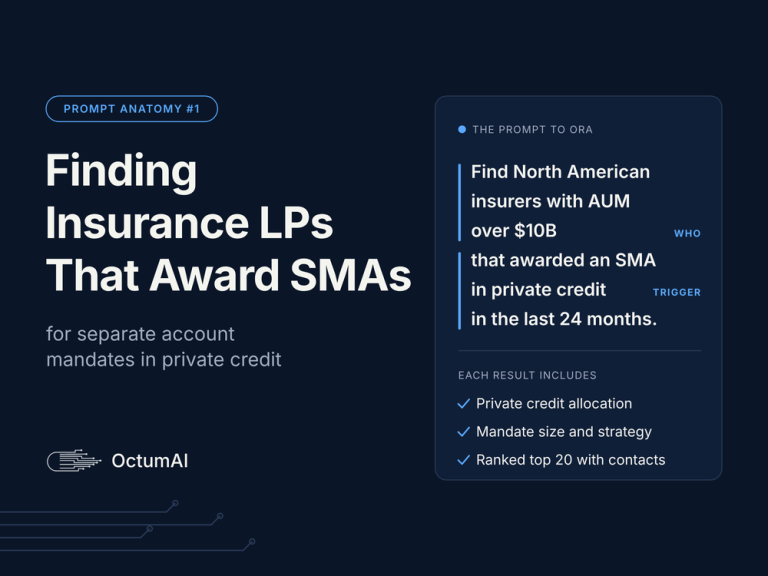
Prompt Anatomy #1 looked at insurers that award separate account mandates. This one is the broader screen underneath it: the whole US general account universe, tiered by whether they can actually buy a commingled direct lending fund. The difference between the two lists is larger than most managers expect.
The prompt
I’m raising a $2B direct lending fund and want to prioritize insurance companies as an LP channel. Filter to U.S. life and P&C insurers with $3B+ in general account assets that have a disclosed private credit or direct lending allocation, or that have made a private credit manager commitment in the past three years. For each insurer give me total general account assets, current private credit allocation percentage, most recent private credit or direct lending commitment with manager name and size, whether allocations run through an internal team or a sub-advisor, NAIC designation considerations if disclosed, and the lead private credit or alternatives contact with details. Tier into Tier 1 (active allocator), Tier 2 (allocates to the space but consultant-gated), and Tier 3 (limited or unclear capacity).
Here is what each piece is doing, and where the leverage is.
The single most important field is “internal team or sub-advisor”
Most managers building an insurance list treat this as an operational detail — useful for knowing who to address the deck to. It is not a detail. It is the field that tells you whether the name on your list is a customer or a competitor.
Insurance private credit runs through three fundamentally different structures. There is the insurer with an internal credit team that originates directly. There is the insurer that outsources to a sub-advisor or affiliated manager under a long-dated separate account. And there is the insurer that allocates to third-party commingled funds as an LP. Only the third one buys what you are selling. The first two look identical to the third in any database that reports “private credit allocation: 8%.”
The distinction gets sharper the higher up the size curve you go. The largest allocations in the sector sit inside insurers owned by or married to alternative managers, where the “allocation” is a capital-formation arrangement rather than a manager selection process. Blackstone alone manages north of $100 billion in investment-grade private credit, grown roughly 40% year over year, nearly all of it for insurance clients. Apollo and Athene, KKR and Global Atlantic, and the Carlyle-backed Bermuda platforms all run some version of the same structure.
Asking the question explicitly in the prompt is what keeps those names from anchoring the top of your list.
Anatomy: what each constraint is doing
“A $2B direct lending fund.” Front-loaded context, and it is doing concentration math on every row before you read it. An insurer with a $4B general account running a 3% private credit sleeve has roughly $120 million committed across every manager it has ever backed. That insurer is not writing you $75 million, and if it writes you $10 million the relationship may not clear your own minimum-account economics. Fund size at the top of the prompt lets the engine sort out arithmetic mismatches rather than handing you a list you have to de-duplicate by hand.
“U.S. life and P&C insurers.” Two different animals, deliberately requested together. Life carriers have the long-dated, illiquid liabilities that make direct lending fit, and the Life RBC formula carries more granularity for Schedule BA assets than the P&C or Health formulas do. P&C carriers have shorter duration, less structural need for an illiquidity premium, and thinner alternatives sleeves. You should expect most P&C names to land in Tier 3 — but asking for them surfaces the handful of large mutuals that do allocate and that almost no credit manager works, because the conventional wisdom says not to bother.
“$3B+ in general account assets.” Note the specific term. Not AUM. General account assets are the insurer’s own balance sheet; separate account assets belong to policyholders and cannot buy your fund. Screening on AUM inflates every carrier with a large variable annuity or retirement business and puts names on your list whose investable balance sheet is a fraction of the headline. This one word substitution changes the composition of the list more than anything else in the prompt.
“Disclosed private credit or direct lending allocation, or that have made a commitment in the past three years.” The two-door screen, and the disjunction is intentional. The first door is policy — a stated target allocation, which tells you the mandate exists. The second door is behavior — an observed commitment, which tells you the mandate is funded and someone is currently buying. Policy without recent behavior usually means a target that has been reached, a program that got quietly deprioritized, or a team that has turned over. Behavior without disclosed policy is common among mid-size mutuals that simply do not publish allocation targets, and those are frequently the least-competed names on the list.
“Total general account assets” and “current private credit allocation percentage.” Sizing and headroom, and the second field needs to be read backwards from how most people read it. More on that below.
“Most recent commitment with manager name and size.” Two jobs. The manager name tells you which sleeve is already occupied — if they just funded a senior middle-market direct lender, you are not the second one in that seat, but you might be the opportunistic or asset-based allocation. The size tells you their actual ticket, which is a far better predictor of what they will write you than any published range.
“NAIC designation considerations if disclosed.” The field most credit managers omit, and the one that decides whether an interested insurer can transact. Covered in its own section below, because it deserves it.
“The lead private credit or alternatives contact.” Insurance investment teams are small and the seat you want is rarely the CIO. It is a Head of Private Assets, a Managing Director of Alternative Investments, or a fixed income PM who carries privates as part of a broader book. These teams also turn over often enough that a contact record older than a couple of quarters needs re-confirming before you draft anything.
The three-tier structure. Tier 1 as “active allocator, no relationship with us yet” is the right definition because it makes the list an outreach queue rather than a market map. Tier 2 as “consultant-gated” is not a demotion — it is a different first call, and we will come back to that.
The gate nobody screens for: capital treatment
Here is the number that ought to reorganize your entire insurance strategy. A direct LP interest in a private credit fund can carry a risk-based capital charge in the range of 30% to 45% for an insurance investor. The senior notes of a rated note fund holding the same underlying assets can be rated as high as A, translating into RBC charges closer to 0.7% to 1%.
That is not a marginal difference in attractiveness. It is the difference between an investable structure and an uninvestable one. A commingled direct lending fund offering only LP equity is, for most general accounts, arithmetically off the table no matter how much the investment team likes your underwriting.
Which is why the rated note fund has become one of the more effective tools in private capital fundraising, with 2025 issuance among KBRA-rated funds setting records and continued growth expected through 2026. It lets a regulated investor hold most of its economic exposure to your fund as debt rather than as equity for capital purposes.
The ground under this is moving, and your prompt should be catching it. The NAIC’s 2024 Discretion Amendment authorized the Securities Valuation Office to challenge ratings on filing-exempt securities where it judges they do not reasonably assess investment risk; the original January 2026 implementation was delayed, but it sharpened regulatory attention on private letter ratings. In January 2026 the NAIC stood up a Credit Rating Provider Working Group, which exposed a due diligence framework for comment on May 4, 2026. And beginning with 2026 reporting, insurers face more granular disclosure on private placements — fair value, Level 2 and Level 3 exposure, payment-in-kind interest, and private letter rating information.
Two consequences. First, engage a rating agency and insurance counsel on structure before the LP conversations, not after — a first meeting where you cannot answer the capital treatment question ends the process regardless of track record. Second, expect the PIK question, because the disclosure line now exists and someone has to fill it in.
The thing this prompt will teach you that nobody says out loud
Sort your finished list descending by private credit allocation percentage and you will have put your worst prospects at the top.
The distribution explains why. Private credit runs around 6% of life insurer general account assets in aggregate, up from roughly 3% in 2020. But of 342 insurer groups, more than half report no private credit exposure at all, and among those that do, the mean is 4.2%, the median 3.1%, and the 95th percentile 10.8%. The names above that 95th percentile are overwhelmingly the alt-manager-affiliated platforms whose “allocation” is captive origination — the exact population that cannot buy your fund. Aggregate growth has also slowed sharply as insurers approach their targets, which means a high number increasingly signals a full sleeve rather than an active buyer.
The productive band is the middle of the distribution: carriers with $3B to $60B general accounts, a real but unfinished private credit target, no affiliated origination platform, and a small internal team leaning on a sub-advisor or consultant for manager selection. That cohort is genuinely active — PitchBook records dozens of debt fund commitments for carriers like Pacific Life, and meaningful counts for Mutual of Omaha and Penn Mutual — and it is where a $2B fund realistically wins allocations.
What you do with the list
- Invert the allocation sort. Work the middle of the distribution first, and treat anything above the 90th percentile as a competitor screen rather than a prospect queue.
- Add state of domicile as a column. Schedule BA limits and the availability of look-through treatment for capital charges vary meaningfully by state. Two carriers of identical size and identical appetite can have very different capacity, and the difference is jurisdictional.
- Add a rated-note history column. Whether an insurer has previously invested through a rated note or rated feeder structure is the single most predictive field for whether you close, because it proves the legal, accounting, and custody plumbing already exists on their side. It is worth more than the allocation percentage.
- Read the last commitment for what is filled, not just for proof of life. Position against the gap in their book, not against your own strategy description.
- Work Tier 2 through the gatekeeper. Insurance manager selection is heavily intermediated, and not only by the generalist consultants. The insurance-specialist advisory and outsourced-CIO firms hold the pen at a large number of mid-size carriers. For those names the consultant is the first call and the insurer is the second.
Variants worth running
- Add “flag any insurer that has previously invested through a rated note fund or rated feeder structure” to build the capital-treatment column directly into the screen.
- Swap direct lending for asset-based finance or specialty lending, which are growing faster than corporate direct lending in the insurance channel and are far less crowded.
- Swap US carriers for Bermuda and offshore reinsurance platforms, a channel with different capital rules and, at the moment, a different regulatory spotlight.
- Add Japanese and Korean insurers with US private credit programs, a cohort that has been expanding into the market and that most US managers never work.
- Add “and identify the insurance investment consultant or outsourced CIO of record” to build the gatekeeper list alongside the LP list.
- Swap the entity type for health insurers and Blue Cross plans, which sit outside almost every credit manager’s coverage map.
One more thing about timing
You are raising into a market where the questions have gotten harder. Fitch reported the US private credit default rate reaching a record 6.0% in April 2026, with private-credit-backed corporate borrowers at 9.2% for 2025. On May 7, 2026, Treasury Secretary Bessent convened NAIC leadership and state commissioners on insurer private credit exposure and the movement of reserves offshore. AG 53 and AG 55 have tightened asset adequacy testing and reinsurance disclosure.
Insurance investment committees read all of this. Put your loss history, your workout capability, and your PIK exposure in the first meeting rather than waiting for the DDQ. A list gets you the meeting; the meeting is now a different meeting than it was eighteen months ago.
Why this is a prompt and not a database query
No investor database has a field for “has a funded private credit target, no affiliated origination platform, has committed to a third-party manager in the last three years, and has previously transacted through a rated note structure.” That answer is spread across statutory annual statements, Schedule BA and Schedule D detail, NAIC filings, rating agency reports, commitment databases, press releases, and conference rosters — with the structural question about internal versus affiliated origination often answerable only by reading who owns whom.
Ora reasons across those sources and returns the synthesis with its reasoning visible, so you can check a general account figure or an allocation percentage against the filing before you build a quarter of outreach on it.
This is the third post in Prompt Anatomy, where we take a real prompt run on Ora and break down why it is written the way it is. Have one you want dissected? Send it to support@octum.ai.
New to Octum? Ora is our research engine for institutional investing, built on GAR, our own cognitive architecture. Join in about three minutes.