
Putting AI Investment Intelligence to the Test
To understand how emerging AI-powered investment platforms compare with established private market intelligence providers, we conducted an independent analysis using ChatGPT.
On July 31, 2026, to conduct a product analysis, we entered the prompt:
“I am a sovereign wealth fund and I want to find investments. Please compare OctumAI to Preqin. I don’t care about fund vintage years. I want deep analysis.”
We used ChatGPT rather than Ora for this analysis to provide a non-Octum perspective and avoid relying solely on a single platform’s native output. The prompt was designed from the perspective of a sovereign wealth fund seeking actionable investment intelligence—not a historical analysis of fund vintages, fundraising cycles, or performance benchmarks. The objective was to evaluate each platform’s ability to identify relevant companies, sectors, technologies, and potential investment opportunities. We ran the prompt once, without iterative refinement, to capture the initial response generated from each platform. The results are presented below.
Below are the results of that analysis in a blend of a screenshot and text.
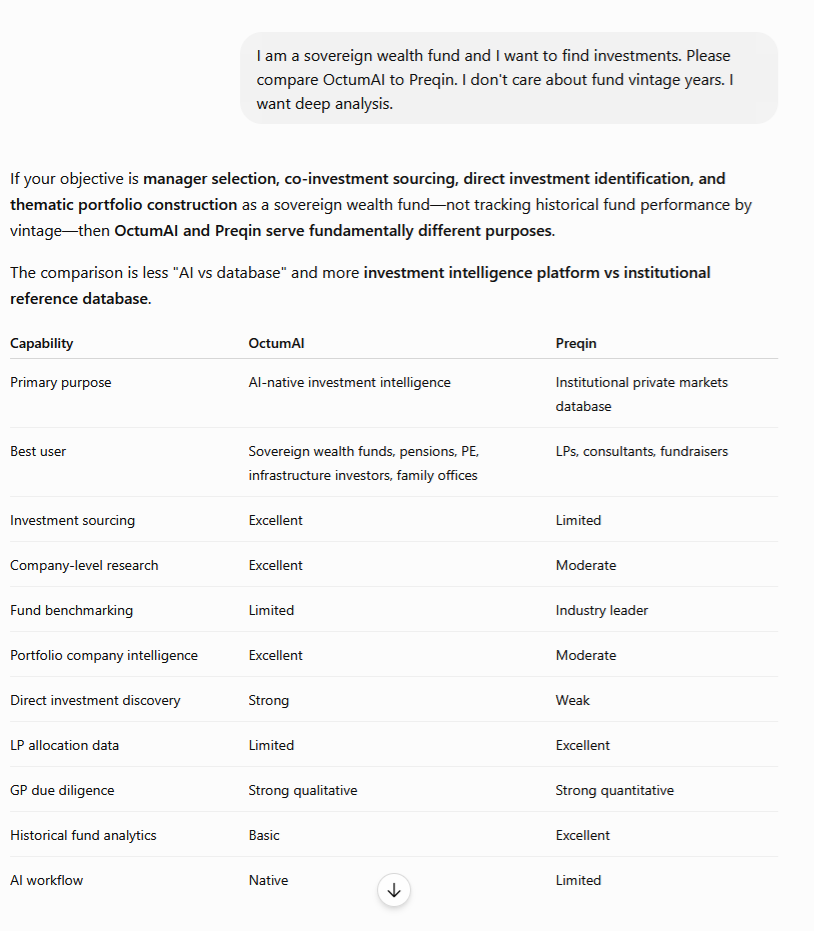
This part we will paste in
Different philosophies
Preqin
Preqin was designed to answer questions like:
- Which PE funds raised capital?
- What were their IRRs?
- Which LPs committed?
- What are benchmark returns?
- What funds exist in infrastructure?
- What are fund terms?
It is fundamentally a structured alternatives database built around:
- funds
- managers
- LPs
- commitments
- fundraising
- performance
- benchmarking
Its data model revolves around financial entities rather than operating businesses. Today it covers tens of thousands of firms, funds, investors, and benchmark datasets built through direct manager outreach and a large research organization.
This makes Preqin exceptionally valuable for:
- manager screening
- portfolio benchmarking
- allocation analysis
- institutional reporting
- consultant workflows
It is much less useful for identifying new operating companies before they become institutional consensus opportunities.
OctumAI
OctumAI approaches investment from the opposite direction.
Instead of beginning with funds, it begins with:
- companies
- sectors
- technologies
- founders
- investment themes
- acquisitions
- venture portfolios
- infrastructure assets
- ownership networks
Rather than asking
Which infrastructure fund raised capital?
it asks
Which infrastructure companies are becoming institutional-quality assets?
Instead of
Which venture fund invested?
it asks
Which startup has already attracted the highest-quality investors and fits my investment mandate?
That distinction matters enormously for sovereign investors.
Direct investment sourcing
This is where the difference becomes significant.
Suppose your investment committee wants exposure to:
- AI infrastructure
- digital identity
- power grid modernization
- data centers
- nuclear
- real estate technology
- logistics
- defense
- industrial software
Preqin will identify:
- infrastructure funds
- PE funds
- venture funds
that invest in those sectors.
OctumAI attempts to identify:
- companies
- founders
- ownership
- investors
- comparable transactions
- strategic buyers
- portfolio overlap
- investment ecosystems
before a transaction exists.
That supports:
- direct investments
- co-investments
- secondary opportunities
- strategic partnerships
rather than simply selecting another GP.
Company intelligence
This is arguably OctumAI’s biggest advantage.
A sovereign wealth fund increasingly invests directly.
Examples include:
- hyperscale data centers
- renewable infrastructure
- logistics platforms
- digital infrastructure
- healthcare
- industrial software
- AI
Preqin contains company information where relevant.
OctumAI is designed around company intelligence itself.
For each company it may aggregate:
- business model
- technology
- customers
- ownership
- investors
- funding history
- acquisitions
- comparable companies
- founder background
- investment thesis
- sector classification
That creates a much richer picture for investment teams evaluating direct equity opportunities.
Theme construction
Large sovereign investors increasingly organize around structural themes:
- energy transition
- AI
- climate
- digital infrastructure
- longevity
- cybersecurity
- industrial automation
Preqin organizes these through fund strategies.
OctumAI organizes them through underlying companies.
For example:
Energy Transition
Preqin:
- Infrastructure Fund A
- Infrastructure Fund B
- Energy PE Fund C
OctumAI:
- Blackstone Energy Transition portfolio
- Sediver
- Shermco
- Trystar
- Energy Exemplar
- Westwood
- Power Grid Components
- Legence
- Transmission Developers
- Geosyntec
- Enverus
The second view is far more actionable for direct investment teams.
Venture ecosystem mapping
Based on the data you’ve been assembling, OctumAI appears designed to connect:
VC
↓
Portfolio Companies
↓
Sectors
↓
Founders
↓
Investment Criteria
↓
Follow-on Investors
↓
Potential Strategic Buyers
↓
Comparable Companies
↓
Institutional Themes
This network view is difficult to recreate inside Preqin.
Investment committee preparation
For an IC memo:
Preqin provides:
- fund returns
- benchmark quartiles
- peer comparisons
- fundraising history
- manager track records
OctumAI can provide:
- market landscape
- competitive positioning
- ownership analysis
- ecosystem mapping
- comparable companies
- sector trends
- strategic rationale
- technology evolution
- investment thesis generation
These are complementary rather than overlapping capabilities.
Sovereign wealth fund use cases
If I were designing the research stack for a large sovereign wealth fund, I would think of the platforms this way:
Preqin
- GP selection
- Fund due diligence
- Benchmarking
- Portfolio reporting
- LP market intelligence
- Fund terms
- Historical performance
OctumAI
- Direct investment sourcing
- Co-investment sourcing
- Emerging manager discovery
- Venture ecosystem mapping
- Company intelligence
- Strategic sector research
- AI-assisted investment research
- Cross-sector thematic investing
Weaknesses
Preqin
- Limited company-level intelligence
- Less useful for direct investments
- Designed primarily around funds and managers
- Historically slower to incorporate AI-native workflows
OctumAI
- Not a substitute for audited performance databases
- Less suited for benchmarking institutional fund returns
- May not offer the same depth of LP commitment history, cash-flow data, or historical performance analytics that institutional allocators rely on for manager evaluation
Bottom line
For a sovereign wealth fund that does not prioritize fund vintage analysis and instead seeks to identify high-quality investment opportunities across venture, growth equity, infrastructure, real assets, and private companies, OctumAI is likely the more strategically aligned platform. Its company-centric, AI-driven approach supports thematic investing, direct deal sourcing, ecosystem mapping, and cross-sector research—capabilities that are increasingly important as sovereign investors expand beyond traditional fund allocations.
Preqin remains the institutional standard for fund-level intelligence. It is strongest when evaluating GPs, benchmarking private market performance, analyzing LP commitments, and conducting manager due diligence using standardized historical data.
For many large sovereign investors, the two platforms would be complementary: Preqin answers “Which managers should we back?” while OctumAI aims to answer “What should we invest in next?”
** END PASTE BLOCK**
AI-generated comparisons are limited by accessible information and should be supplemented with direct platform evaluation.
The comparison between Preqin and OctumAI reflects a broader shift in private market intelligence: from static databases toward actionable investment intelligence. Preqin remains a powerful resource for institutional fund data, manager research, and market benchmarking. OctumAI represents a newer approach focused on helping investors identify opportunities through deeper intelligence layers, including LP allocation data and investment relationship insights.
This analysis should not be viewed as a definitive ranking, but as a starting point for understanding how different platforms approach the investment research process. For sovereign wealth funds, the ultimate measure is not the volume of information available—it is the ability to convert data into actionable investment decisions.